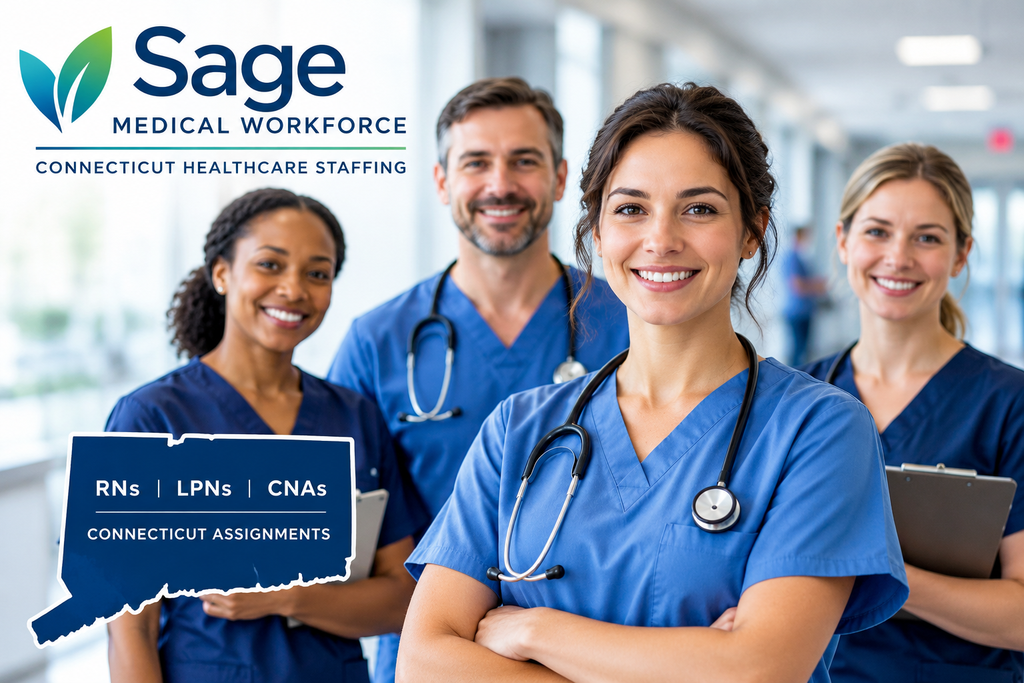
Connecticut Healthcare staffing agency Sage Medical Workforce connects qualified RNs, LNPs and CNAs with healthcare facilities throughout Connecticut. Missed shift can change the pace of an entire unit. When patient census rises, a nurse calls out, or a facility needs coverage for an open position, a temporary health care services agency helps keep direct-care teams staffed with qualified RNs, LPNs, and CNAs.
For healthcare professionals, agency work can create a practical route to Connecticut assignments that match current credentials and hands-on care experience. For facilities, it provides access to nursing talent when internal hiring timelines and daily staffing needs do not line up.
What a Connecticut Healthcare Staffing Agency Does
A healthcare staffing agency connects clinical professionals with facilities that need direct-care support. The agency recruits candidates, reviews qualifications, coordinates placement opportunities, and helps employers identify professionals for temporary, per-diem, or ongoing staffing needs.
The work is specific to the role. A Registered Nurse brings a different scope of practice and clinical responsibility than a Licensed Practical Nurse or Certified Nursing Assistant. Effective staffing starts by matching the facility’s actual need with a professional whose license, certification, experience, and availability fit the assignment.
That distinction matters. A facility may need an RN with experience managing complex patient needs, an LPN prepared for routine nursing care within the appropriate scope, or CNAs who can provide essential daily support. Treating those roles as interchangeable creates risk for patients, teams, and the professionals being placed.
Sage Medical Workforce focuses on these essential clinical roles, recruiting qualified RNs, LPNs, and CNAs nationwide for staffing opportunities centered in Connecticut. The goal is straightforward: connect credentialed professionals with facilities that need reliable direct-care coverage.
Why Facilities Use Temporary Healthcare Staffing
Temporary staffing is not only a response to emergencies. It can be a planned workforce tool when a facility is managing patient-volume changes, employee leave, seasonal demand, recruitment delays, or ongoing vacancies.
A permanent hire takes time. Facilities must advertise the opening, screen applicants, interview candidates, verify qualifications, complete onboarding, and confirm a start date. Those steps are necessary, but patient care continues while the hiring process is underway. Temporary staffing can help bridge that gap.
It also gives employers flexibility. A facility may need coverage for a few shifts, support for a defined period, or a more consistent schedule while building its permanent team. The right arrangement depends on census patterns, unit needs, orientation requirements, and the level of care provided.
There is a trade-off. Temporary professionals can stabilize coverage quickly, but they still need clear expectations and a proper introduction to the facility’s workflow. The strongest results come when agency staff receive unit-specific direction, know who to contact with questions, and are treated as valued members of the care team from the start of the shift.
A Clear Request Leads to Better Matches
Facilities should communicate more than a job title. Useful staffing details include the shift schedule, assignment length, patient population, required credentials, experience expectations, documentation system, orientation process, and any unit-specific duties.
Specificity helps an agency recruit and present candidates who are prepared for the work. It also gives nursing professionals enough information to decide whether the assignment aligns with their skills and schedule. A clear request saves time on both sides and reduces the chance of a mismatch.
What Nurses and Nursing Assistants Should Expect
For RNs, LPNs, and CNAs, working with an agency begins with professional readiness. Candidates should be prepared to share current licensure or certification, work history, clinical experience, availability, and the type of Connecticut assignment they are seeking.
An agency relationship should not feel like sending an application into a void. Candidates need direct information about the role, facility expectations, shift needs, and next steps. A credential-aligned opportunity is more useful than a broad promise of work that does not reflect the professional’s actual training or experience.
Healthcare professionals may choose temporary assignments for different reasons. Some want steady access to work while considering long-term career options. Others value schedule flexibility, want to gain experience in a new care setting, or are relocating to Connecticut. Experienced clinicians may be looking for assignments that use a specialized background rather than placing them in a role that does not fit.
Temporary work requires adaptability. Each facility has its own routines, leadership structure, documentation practices, and team culture. Clinicians who communicate early, arrive prepared, follow facility policies, and ask questions when they need clarification are better positioned to make a positive impression.
Keep Your Credentials Ready
Staffing opportunities can move quickly when facilities need coverage. Keeping documents current helps prevent delays between an available assignment and a possible placement. Before pursuing agency work, professionals should have the following ready:
- Current RN or LPN license, or CNA certification, as applicable
- Recent work history and relevant direct-care experience
- Required identification and employment eligibility documentation
- Current compliance records requested for the assignment
Requirements can vary by facility and role. A candidate should never assume that a credential alone answers every onboarding question. Timely, accurate documentation is part of being ready for placement.
Choosing the Right Agency Relationship
Not every Connecticut healthcare staffing agency serves the same roles or markets. A general recruiting firm may handle many industries, while a Connecticut healthcare staffing agency understands the practical differences between nursing and nursing-support positions.
Candidates should look for an agency that clearly identifies the credentials it recruits and the locations where it places professionals. If the goal is a Connecticut assignment, the agency should be able to discuss opportunities in that market directly rather than offering vague national possibilities.
Facilities should look for the same clarity. The agency should understand whether the request calls for an RN, LPN, or CNA and should communicate openly about candidate qualifications and availability. No staffing partner can guarantee that every request will be filled immediately, especially when specialized experience or short-notice coverage is required. Honest communication about timing is more valuable than overpromising.
Questions Worth Asking Before Placement
Candidates benefit from asking about the facility type, shift schedule, expected duties, orientation, reporting structure, and assignment duration. They should also confirm what documentation is needed before they can begin.
Facilities working with a Connecticut healthcare staffing agency should ask how the agency verifies credentials. What information it collects about relevant experience, and how it communicates if staffing needs change. These conversations are practical, not administrative extras. They establish expectations before a professional arrives on the unit.
Building Better Coverage Through Better Communication
Staffing success is often decided before the first shift begins. A facility that communicates its needs clearly can receive more suitable candidates. A nurse or nursing assistant who accurately represents credentials, experience, and availability can be considered for assignments that fit. A Connecticut healthcare staffing agency that keeps both sides informed can reduce confusion when schedules, requirements, or census needs change.
For facilities, that communication may mean giving prompt feedback after a candidate is presented or notifying the agency as soon as a schedule changes. For professionals, it means responding to requests, maintaining current credentials, and being clear about availability. Reliability is built through these small actions.
Temporary staffing works best when it supports care rather than merely filling a name on a schedule. The right RN, LPN, or CNA can help a unit maintain continuity, protect workloads, and give patients the attention they deserve. When an opportunity or staffing need arises, start with the role, credentials, and schedule that are actually required – then make the connection with confidence.
Need Healthcare Staff in Connecticut?
Sage Medical Workforce connects Connecticut healthcare facilities with qualified RNs, LPNs, and CNAs for temporary staffing needs. We also welcome qualified healthcare professionals nationwide who are interested in assignments located in Connecticut.
Need staff? Contact Sage Medical Workforce
Looking for Connecticut assignments? Apply to Join Our Workforce
One Response